Pad Print Inks and Additives
Learn more about our ink expertise, ink series and compatible substrates.
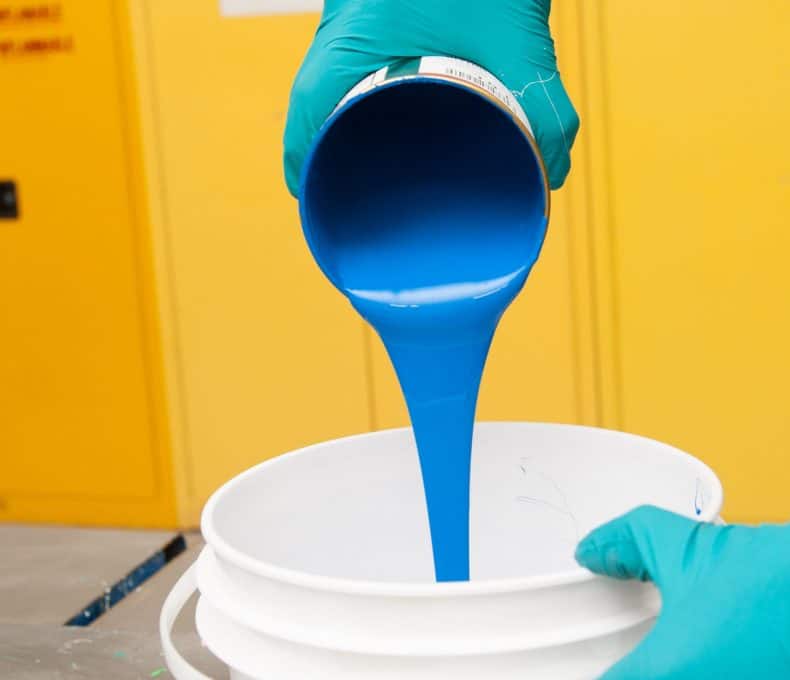
Trans Tech is proud to be the market leader in pad printing ink – with the largest pad printing ink warehouse in the country!
Our deep understanding of ink performance combined with our familiarity of the entire pad printing process (from art development through production) allows us to provide inks designed to deliver quality performance from your first print to your last.
The Trans Tech Ink Lab offers:
- 1- and 2-Component Inks, UV Inks
- Performance Inks – High Density, Abrasion Resistance, Chemical Resistance, etc.
- Medical Class VI Inks
- Metallic & Process Color Inks
- Additives (hardeners, thinners, adhesion promoters, specialty additives)
- Standard Colors
- High Precision Custom Color Ink Mixing
The experts in the Trans Tech Ink Lab can pinpoint the best ink for your unique application combining our knowledge of compatible substrates with a long list of considerations impacting your print requirements.
Please visit our Resource Center for Safety Data Sheets (SDS), Compliance and Technical Data reports.
INK-B Ink Series
- 2-component ink
- Automotive, technical/industrial applications requiring high mechanical and chemical resistance
- Compatible Substrates
INK-P Ink Series
- 1- or 2-component ink
- Exceptionally easy and reliable printability
- Compatible Substrates
INK-PG Ink Series
- 1-component ink
- Flexible substrates
- Compatible Substrates
INK-UV2002 Ink Series
- 1-component UV curing ink series
- Compatible Substrates
INK-W Ink Series
- 2-Component ink
- Exceptionally high mechanical and chemical resistances
- Compatible Substrates
INK-434 Ink Series
- 1-component ink
- Untreated polypropylene (PP)
- Compatible Substrates
INK-478 Ink Series
- 1- or 2-component ink
- Outdoor applications
- Formulated with environmentally compatible raw materials
- Does not contain aromatics, butyl glycolate (GB-Ester), cyclohexanone, Bisphenol A (BPA) or polycyclic aromatic hydrocarbons (PAH).
- Compatible Substrates
INK-SK Ink Series
- 1- or 2-component ink
- Demanding substrates, “soft touch” coatings, rubber, leather, and synthetic leather.
- Compatible Substrates
Additional Inks, Thinners, Hardeners, Additives
- Contact Us for information about additional ink series, thinners, hardeners, and other additives!
| Substrates | |
| INK-B Ink Series | Thermoplastics, especially pre-treated polyolefines (PP, PE), PMMA, Polyamide (PA), cellulose acetate, various duroplastics, metal, and coated surfaces. |
| INK-P Ink Series | Thermoplastics such as pre-treated polyolefines, i.e. polypropylene (PP), polyethylene (HD-PE, LD-PE), PMMA (“acrylic glass”), polycarbonate (PC), polyamide (PA), Polyester, polyacetal (POM, flame-drying), polyurethane, rigid PVC and polystyrene, various duroplastics, metals, coated surfaces, wood and paper |
| INK-PG Ink Series | Thermoplastics, especially rigid and plasticized PVC, polycarbonate (PC), PMMA (acrylic glass). Also limited suitability for polystyrene (PS), ABS and SAN. |
| INK-UV2002 Ink Series | Thermoplastics ABS, polycarbonate (PC), polystyrene (PS), styrene-acrylonitrile, misc. metals, misc. coatings & paints. |
| INK-W Ink Series | For metals, coated surfaces and duroplastics. Also for thermoplastics such as pre-treated polyolefines (PP/PE), PMMA, PA, POM, PU and PES. |
| INK-434 Ink Series | Untreated polypropylene (PP) |
| INK-478 Ink Series | Thermoplastics, especially for technical-industrial applications, ABS, SAN, ASA, Polystyrene (PS), Rigid PVC, PMMA (acrylic glass), polycarbonate (PC). If processed as 2-component system, can be printed on some coated surfaces, metals and copolymers. |
| INK-SK Ink Series | Demanding substrates including polyamide (PA), polyurethane (PU), thermoplastic elastomers (TPE, TPU, TPS etc.), “soft touch” coatings, rubber, leather and synthetic leather. |
For technical datasheets, safety data sheets (SDS), and ink certifications, please visit the Resource Center.